
Category Archives: Stress Reduction

Flora From A Walk

Wrapping up our extended stay here in Kona, Hawaii, we continue to marvel at the sights and sounds of the area.

We will sorely miss the sounds featured in last week’s post, when we return home on the mainland, along with the daily eye candy of flowers seemingly constantly in bloom.

The main reason for visiting here is family – gathering around a beautiful new life and marveling at the daily changes – so, we are not going on long-walking or hiking treks about the area.

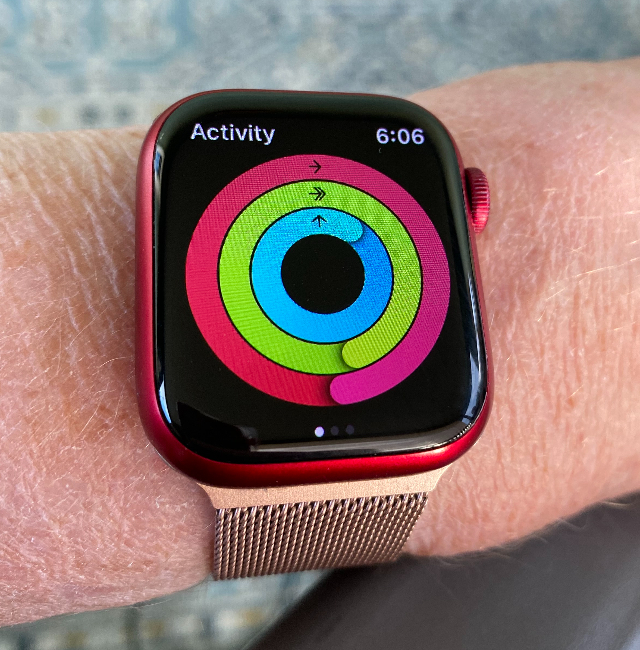
Strangely enough, however, the motivation of closing those circles on our Apple watches for standing, exercise, and movement have given us reason to walk back and forth on the long, slopping driveway where we are staying.

Back and forth. Down the hill and up the hill.

Boring?

Hardly.

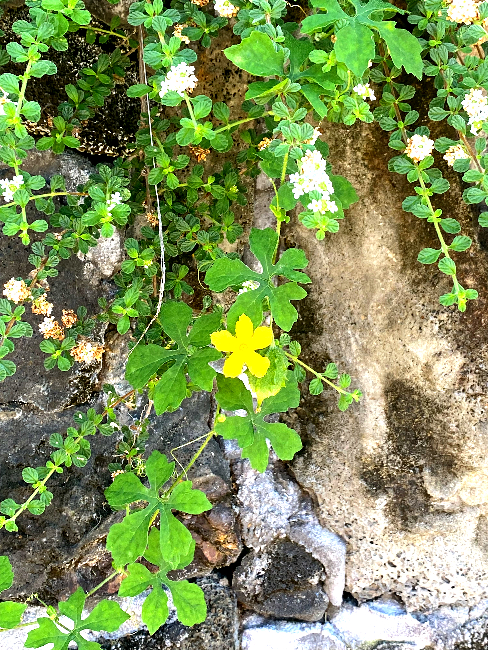
It’s hard to keep our pace on these walking exercise laps because we want to stop every few steps to admire yet another stunning flower. Even what must be weeds, appear glorious and dignified in their splendors.

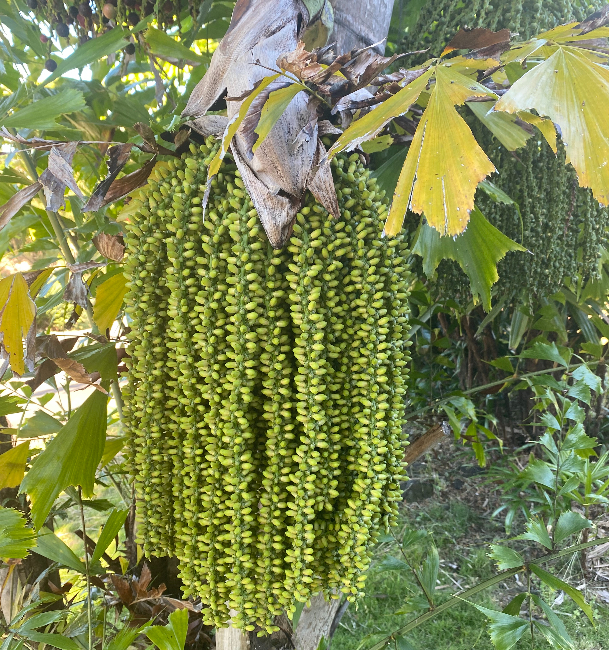
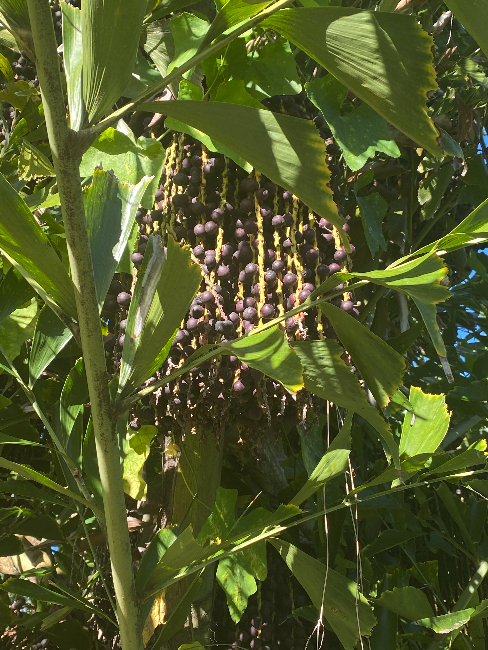
Cascades of berry-like structures on the fishtail palm, morph in their curious appearance as different clusters mature – we are advised not to eat these, despite their cranberry-ish appeal.

Hibiscuses thrive here and inspire me to try growing one back home to enjoy, even if only for the summer.

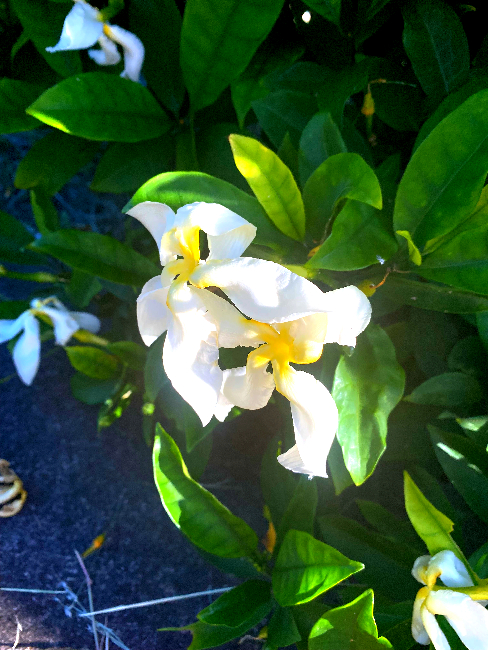
Cinnamon gardenias delight our senses with their long, drooping petals and soft scent as we pass.

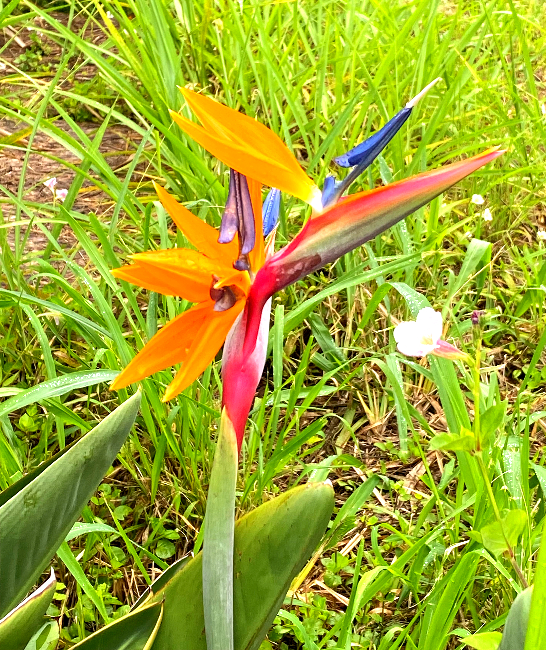
Who among us is not in love with Bird of Paradise?

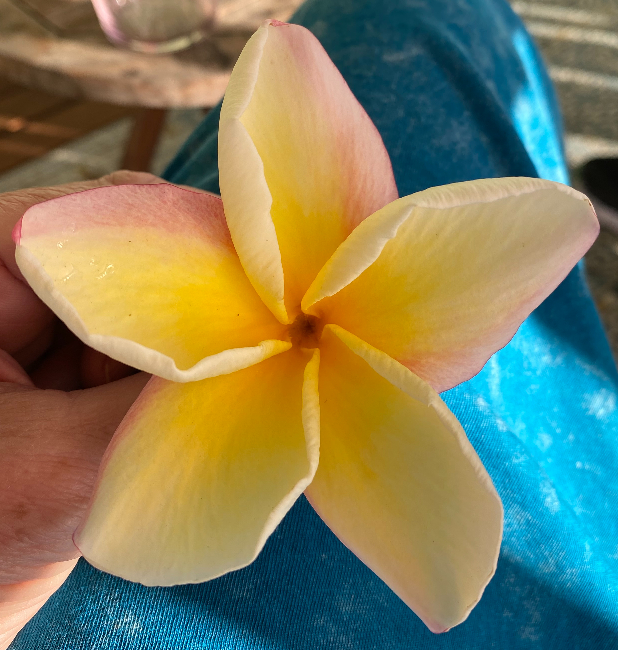
Plumeria – the flower of choice for ladies’ hair – are everywhere and in assorted colors and scents.

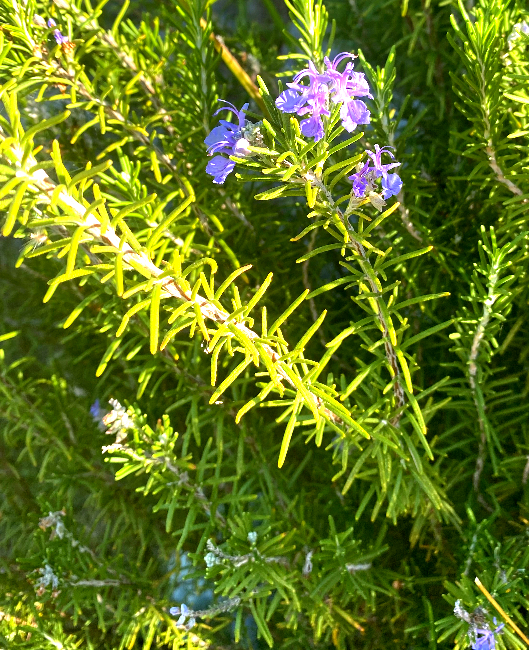
Rosemary bushes not only provide visual appeal in their texture, but taste in our cooking; and, in Hawaii at least – a significant source of beautiful flowers.

Exotic fruits growing high up in the trees.

Tiny flowers almost hidden in the base of large red and green leaves.

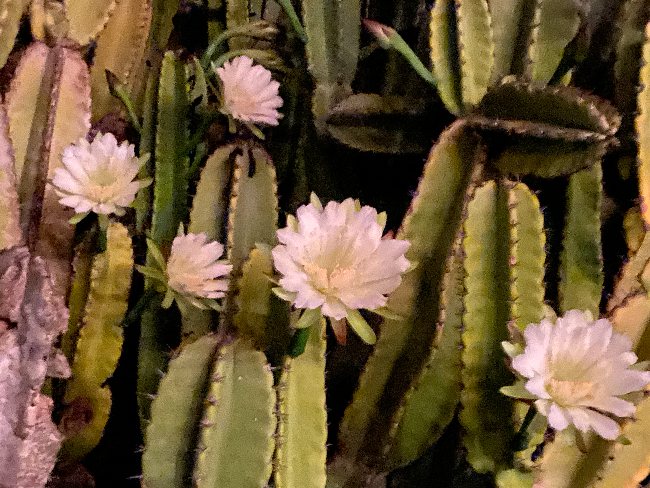
Not on our daily walk, but there’s a giant flowering cactus at my daughter’s home – it blooms only at night!

We feel like kids in a candy store!

Upon our return home, I’ll be heading to the nurseries to see what I can plant to create a little bit of paradise – North Carolina style.

We love hearing from you! What are you planting to create your own garden oasis?

Aloha!

In health –

Deidre

“Tiny Bubbles, Make Me Feel So Fine” – Sights and Sounds From Hawaii!

Sounds and their sources … 

Isn’t it fun to experience different sights and sounds as we travel?  

Whether we are gazing at magnificent buildings and structures, admiring sunsets from new perspectives, or hearing the deep sounds of the ocean liner horn, new venues fascinate. 

Visiting my daughter, son-in-law, and their beautiful newborn, we are trying to absorb, not only the love of family and the miracle of new life, but also the sights and sounds delighting our eyes and ears in Hawaii. 

Sure, it’s a tropical paradise – especially to the eyes – but we marvel equally at the sounds. 

Oh, the sounds! 

One may think of typical tropical birds – such as green parakeets and parrots – but our days start around 5:15 am with the forte sounds of cock-a-doodle-do, from numerous wild roosters around our semi-countrified, suburban neighborhood! 

Simultaneously, the requisite broods of hens join in greeting the day along with the chirp-chirp of their young – numbering in the double-digits, right outside our open windows, but hidden from sight by the bushes. 

Not to be left out are the turkeys! Wild Tom turkeys, their hens, and their young are excited to vocalize as they stroll about, pecking for breakfast.  

Zebra doves wake up to join the chorus with their familiar cooing – Hawaiian style. 

Not to be out-done, the invasive species of Puerto Rican Coqui frogs end their night-long LOUD chorus with final blasts of “co-KEE” – only to resume at sunset as they destroy the relative calm of night – once owned only by the crickets. 

Take a listen to a Coqui frog:

Myna birds fill the air with their distinctive calls. 

It’s all so fascinating! 

Need a rooster’s help to get you up and going? Listen carefully. Here it is!

Anyone who grew up watching cartoons will tell you that roosters crow at dawn. Ha! They start at dawn and continue until it’s time to roost in the evening! Having not grown up on the farm, I didn’t realize that fact – it took a trip to Hawaii to become enlightened. 

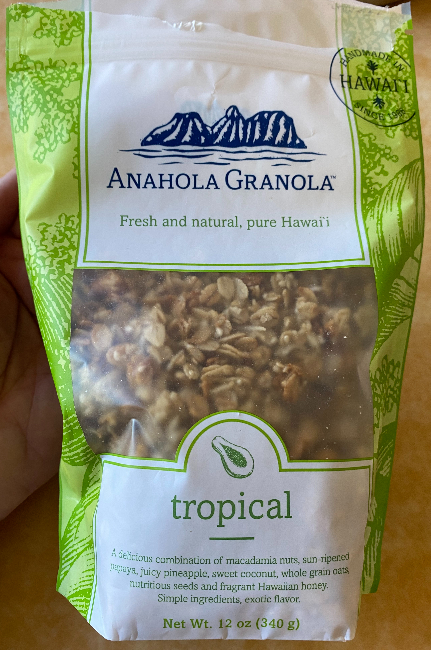
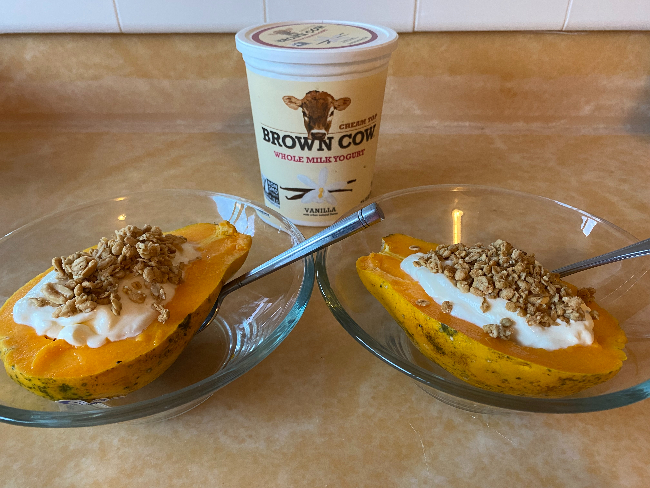
Locally grown fruits and vegetables have their own flair – offering deeper, truer flavors. So, we listen to the backdrop of bird conversations, while our morning papaya bowls satisfy our tropical tastes – complete with Hawaiian granola! 

May your day fascinate wherever you are. Sheree has attached soundtracks I recorded for your enjoyment and relaxation.  

I left the best for last – a melodious song from our feathered friends of the Hawaiian Islands!

Aloha, in health –  

Deidre  

Shhhhh! Cascade – Pass It On

Cascading.

The extent to which we control our health is the subject of my recent deep dives in reading.  

As a culture, we have come to understand that controlling factors in our external environment – along with what we put into our bodies – has a direct correlation to our health and longevity.  

Nicotine, for example, is bad for our lungs and cardiovascular system. The link of cigarette smoking and secondhand smoke to cancer and heart disease was eventually accepted by our society, and policies to restrict its use and exposure to bystanders are now the norm – although that process took decades. 

Not so for other countries around the world who think we are unreasonably possessed and controlling in our zealous quest to stop smoking. They light up whenever and wherever they please, thank you. 

So, it’s easy to see it’s going to be a harder ‘sell’ to shine a light on how influential our inner environment – created by how our thoughts change the chemistry in our body – is on our health. 

Even when I am learning about the influence of positive or negative thinking, the application of my knowledge is spotty. 

Sigh. 

But we learn from our mistakes, right? 

I know that everything I think is my choice. Sure, I may have been conditioned by circumstances to respond to situations in a certain way, but as a reasoning adult with access to the latest information, I can gain tools to think and respond differently.  

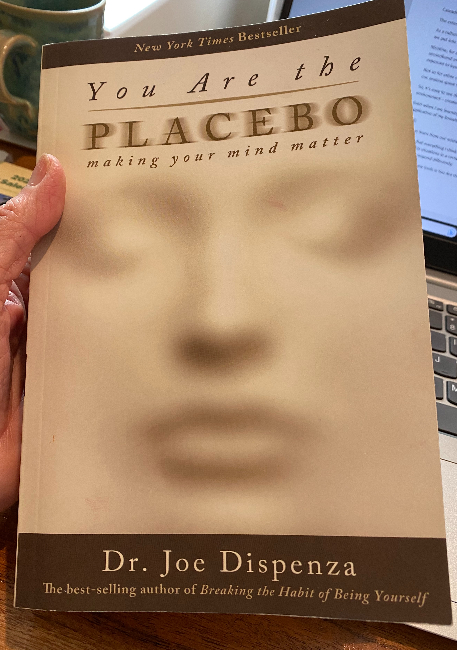
One of my new tools is, You Are the Placebo, by Dr. Joe Dispenza. This book is broadening my understanding of what is physically happening when we think and how thought can change so much relating to our health. 

So – returning to last week’s mention of an exploding glass dish that sprayed tiny shards all over my kitchen and beyond – I had a choice to make. 

Explode like that glass bowl – or not. 

After the initial reaction of dismay – this was a marvel in glass breaking, I must admit – I was immediately disheartened at the extent of the damage.  

An open dishwasher with clean dishes exposed to breakage. Open deep drawer of dishes sprayed with glass shards. A just-cleaned floor littered with glass and carpet nine feet away with glitters of glass. 

Everything in sight had to be cleaned, recleaned, and cleaned up again. Broom. Gloves. Vacuum. Wiped. Over and over.  

Surely, I deserved a meltdown or just a bit of rage. You think? 

I knew I was in control of my reaction. My mantra is, after all, my mind believes what I tell it. I needed to be careful how I related to this inconvenience. Really, it was not life-altering, after all. 

The slow burn of discouragement of having all my earlier work wiped away came to a crescendo when I was asked, “What happened”? 

Then I chose to let loose. I chose to label all the negative things directly and capped it off with how ticked off I was.  

So there! 

Probably even a little dramatic. 

I thought venting would help. Wrong. A wave of negativity physically flowed through me even hours later.  

I was emotional earlier in the day. What I was feeling that night was physical. 

Examining why I had chosen to be as emotional as I was at the time, has proven to be helpful. Sometimes there are subplots to our outbursts. 

I am not advocating ignoring emotions – but a few messages were driven home for me.

1) I could have chosen to laugh at the absurdity of my predicament.

2) I could have asked for help.

3) I could have measured my verbal response to be less dramatic.

It was a matter of choice. I am here to tell you that I physically felt the ramifications of that choice hours later. 

We’ve heard, “you are what you eat.” I can add another aspect to that, “you are what you think.” 

Continue the conversation by sharing using the options under the MORE button below. 

Right there learning with you –  

Deidre  

Embrace The New!

New.  

It’s such a short word. 

To some, it inspires excitement and adventure. To others, it terrifies. 

There have been times when I longed for the comfort of sameness. No surprises. Just wind me up and let me go unimpeded.  

I would have loved to just routinely put my dishes away this week. However, a glass bowl virtually exploded in my hand – raining down shards over an open dishwasher filled with clean dishes, and even into an exposed open drawer and beyond! Of course, it then flew over freshly cleaned floors. (More on the aftermath of that next week). 

That was taxing enough, but day-after-day repeats? 

Even good repetitions can be suffocating for me.   

Why? It’s not a matter of being a thrill seeker, but I have a deep desire to not live the same day repeatedly. (Remember the movie Groundhog Day?)  

Why would I want to paint the same picture on every new page? 

My young adult self was very unsure about the concept of the future, setting goals, change, new beginnings, and anything unknown. There was a struggle within between ‘going with the flow’ and ‘being the master of my own ship.’  

As I have aged and have watched and experienced the unpredictability of life for everyone, there is no desire to lather/rinse/repeat with my time. 

Knowing I am the only one in control of my life, even when visiting the same restaurant, I want to branch out from my location-specific choices of old to discover something new.  

Taking a walk this morning saw us on a new path through the neighborhood. Discovering more houses being built inspired us to walk around the build sites, where we observed new interesting home features.  

Even while doing the familiar, there is something for us to discover that is new. We must actively look for it.  

Need I add, it takes us looking away from our cell phones to really see the world around us? To experience something new, we must be present in the moment. 

How are you experiencing newness? Can you do, think, learn, and create something unique or distinctive right now, today, and tomorrow? 

Can you find the blessing in your new experience?  

Speaking of blessings, happy birthday to our editor, Sheree Alderman, who is not only starting a new year, but charting several new courses! It will be a grand ride, Captain! 

In health –  

Deidre  

And Now – The Holistic Angle on Caregiving

For certain, there’s more than one way to tell a story!  

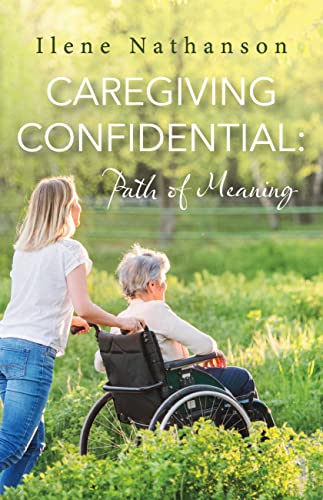
As a practical, roll-up-my-sleeves author who reaches out to caregivers with a skills-oriented how-to approach, I was delighted to become aware of Ilene Nathanson’s book, Caregiving Confidential: Path of Meaning, because of her different style and message. 

Weaving true story vignettes that walk the reader through the unfolding of several common pathways to caregiving, Dr. Nathanson’s passion for the holistic needs of caregivers and care recipients is evident on each page. 

I was immediately drawn into her narrative style that cleverly brought me through the broad range of circumstances that will, ultimately, confront us all – maybe several times in our lives. 

There is no escaping the issue.  

We are all aging.  

Our needs, and the needs of our loved ones, are going to evolve – and most of us are unprepared. 

As a retired chief administrator of graduate social work at Long Island University, with a strong passion for gerontology, her guidance and teaching skills continue in this book and in her co-founding of the New Aging Partnership.  

Did you know that the phrase “aging in place,” is the buzz word not only for longings of the heart, casual conversations, and policy makers, but is also the focus of dozens of new and old industries? 

Retirement communities have been with us for decades, but now there are real estate agents focusing on senior needs, downsizing specialists, senior service agencies, and more – who are all swooping in to meet the unfolding needs of this growing niche market.  

Sandwich generation families are rewriting the book for taking care of parents/grandparents, while juggling the demands of their own children, plus full-time jobs in or outside of the house.  

The dynamics of multi-generational households are different than in previous years. 

This is why Caregiving Confidential is a beautiful place to start. Enjoyable to read and laced with poignant humor – Ilene Nathanson’s book is always spot on. Like me, you will not want to put it down. 

I consider it to be the perfect flashlight for us to use as a primer for this timely topic and a great place to start the aging conversation in our own families. 

We are all about sharing here at foodtalk4you. Please share this post using the options under the MORE button below. 

In health –  

Deidre  

Happy 9th Anniversary! So, What’s Your Type?

Marking major passages of time seems to naturally cause introspection.  

Another year passes – what went well, what could be improved, what is needed? 

A funny thing happened as I cleaned up the remains and results of tax preparations this past week. Not only was I vacuuming up the tiny, spilled scraps of ancient tax documents, now shredded, but I was also filing random papers that had not found their proper place in my new home. 

My office floor was covered with files, papers, articles, notes taken – heaven help me, I am a consummate note taker – and one last bundle was in my hand.  

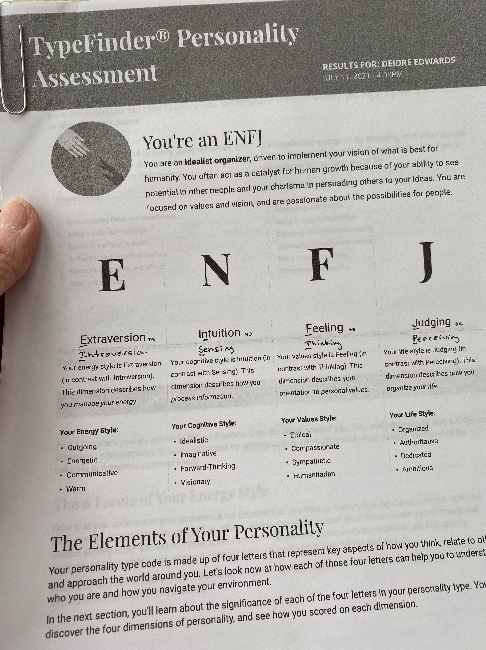
I was holding the results of the personality test I took a couple of years ago, and strangely enough, it was the topic going around the table the other night as we dined with friends. Everyone knew their alphabet soup of personality types the same way they knew their astrological signs!  

Well, except me. It seemed like such a jumble of letters. ENFJ just doesn’t roll off my tongue. 

But reviewing the 18 pages of explanations helped my understanding of what makes me roll.  

Coupled with today being the 9th anniversary of foodtalk4you, I am more committed to continuing my natural bent to guide, teach, and mentor – both here, and in my books and presentations. 

As we go forward with conversations about lifestyles – including exercise, food, and positive thinking – I do realize each of us is coming to these topics from diverse backgrounds, start points, and experiences. 

My promise to readers and listeners is to maintain a thoughtful approach that will uplift and encourage everyone, sharing tools and skills that can be adapted to our unique situations.  

Above all, we will collectively move forward with healthier thoughts, a greater appreciation for all that does our body good and sharing helpful information. 

There are many avenues to taking an online Myers Briggs type test. The TypeFinder Personality Assessment test I used was free to take, but I recall a slight fee to have the results fully explained. It was totally worth it. 

It’s illuminating to read about how we tick. The section, “Your Personality at Work,” discussed the work environment best suited to my personality followed by my own leadership and teamwork styles.  

How cool it was to see my career and life experiences span 1/3 of the 45 good fit recommendations tailored to my personality type.  

LOL! I may be onto something!  

Our foodtalk4you anniversary gift idea to you is TypeFinder – check it out. 

You may share this post using the options under the MORE button below. 

In health –  

Deidre    

It’s Electric – With Mind Over Matter

It’s just a thought.

What’s the big deal? We think lots of thoughts.

No harm – no foul, right?

Nothing hurtful was spoken. No punches were exchanged.

“I can think anything I want!”

Well, not so fast, grasshopper.

Turns out, even our most fleeting of thoughts has significant consequences inside of our bodies.

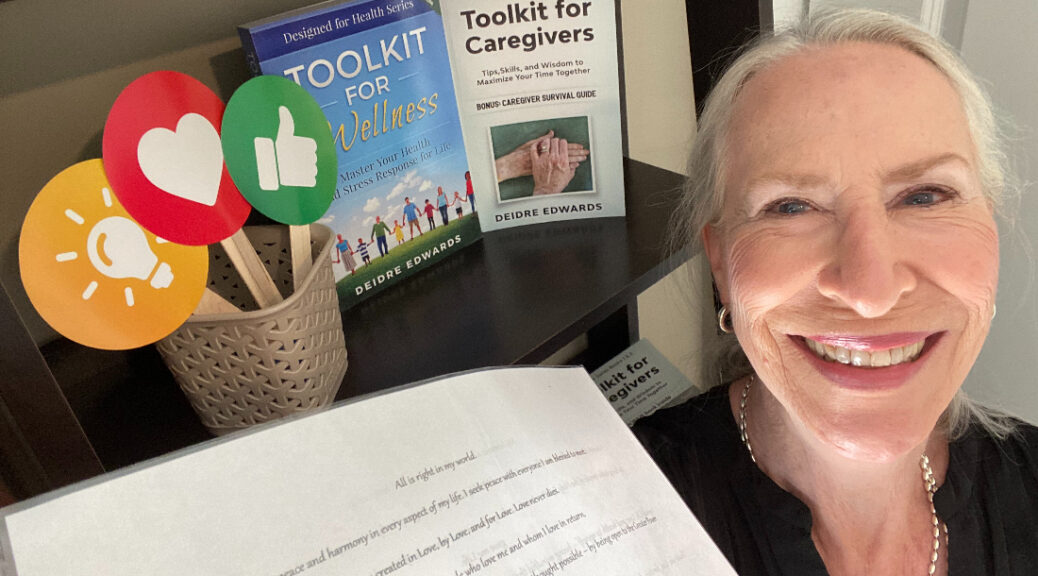
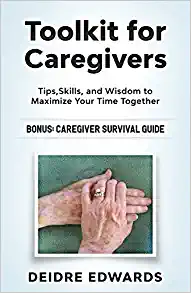
I have written about the effects of negative self-talk before in foodtalk4you, and my new book, Toolkit for Caregiver Emotions, (out this summer) has a section about managing the inner dialogue as well. The more research I do about the power of our thoughts, the more I want to practice, learn, and share with you.

The most recent foray into this science of the mind, stemmed from an article my daughter shared with me: Somatic Movement Center – Placebo Effect, which has started a cascade of reading – and well, thinking.

Please read that article. Copy and paste it into a word document. Reread it. Highlight it in a rainbow of colors. Reread it again. Add italics. Underline. And reread it again. Absorb its meaning and the implications to you.

Here’s a glimpse of what I have gleaned:

Only about two percent of diseases, can be blamed on single genes and can be considered truly unavoidable.

The vast majority of us are born with genetics that can allow us to be healthy throughout our lives—given the right environmental conditions.

Research shows that only 5% of an adult’s genes are unchangeable; the other 95% can be turned on and off by environmental factors.

What exactly is the environment? The environment that affects our genes includes factors outside our body that we may have limited control over, and inside our body that we potentially have total control over.

Genes do not randomly turn themselves on and off. The majority of genes are inactive until an environmental signal tells them to turn on. And once they’re turned on, they require an environmental signal in order to be turned off.”

Do you wonder what the environmental signals are?

We create those environmental signals inside of our bodies.

How?

By the nature of the thoughts we think. Our thoughts generate electrical signals that course along the nerve cells in our brains, which direct what kind of a protein, called a neuropeptide, is released.

As those neuropeptides are swimming around our bodies, our individual cells pick them up through receptors:

“The input that the receptors receive affects the behavior and structure of the cell. So as we have thoughts and experience emotions, the activity and structure of the trillions of cells throughout our body are affected.”

Eventually, the genes found in the cell’s nucleus/brain are influenced to start a cascade of events that will turn on or off the expression of that gene. In other words – you may have inherited genes for XYZ disease/condition, but you are in control of creating the environment that will turn those genes on or off.

This is a lot to take in.

There is rock hard science behind people getting out of wheelchairs, fighting the odds, or beating diseases. We will be revisiting this topic in future posts.

For this week, let’s practice running our inner dialogue through the parameters of what this article is revealing to us.

Remember: Our mind believes what we tell it. We, alone, can reprogram our thoughts to generate better outcomes within our bodies.

Thinking health in all things,

Deidre

Sometimes it’s a recipe; sometimes it’s an idea or an exercise. You never know what’s coming up next; but you can be assured it’s something that’s good for you. Scroll to the bottom of your device or to the top left of your computer screen to subscribe to foodtalk4you today. No gimmicks. No hype. Thanks.

A Little Sneak Peak …

Last week, I mentioned our good news about Toolkit for Caregiver Emotions, being available for pre-order on Amazon, and it occurred to me it might be nice to share a snippet of that book with you today.  

Here is the first part of Chapter 2, where I introduce readers to the first technique we do as an exercise that: 

1) Assists people in understanding how much control they have over their emotions  

2) How to create an accepting mindset and environment for emotions, and  

3) How to, at least temporarily, let it go.  

I am also introducing caregivers to the idea that they count. Their total health is a valid focus that needs to be recognized, so they can successfully be there for their loved one/patient.  

Here is your peek inside of Toolkit for Caregiver Emotions

Chapter 2 

Are you drowning? 

We caregivers of loved ones often think we should just soldier on in silence. Don’t complain. Don’t reach out for help. Just do the job. Any feelings we experience about ourselves are pushed so far down they are out of sight. 

Our loved one comes first, last, and everywhere in between.  

That philosophy may work for a while … until it clearly does not. 

I can tell when it’s not working. Caregivers come to talk to me with that glazed-over, shell-shocked look, like they are drowning at sea and are going down for the third time – lacking the energy to even signal for help. 

A greater understanding of the unique caregiver emotional situation will assist you in smoother transitions through the phases of caring – and even grieving. 

I thought I had everything figured out when I started caring for my dear husband. I was a nurse who taught Certified Nursing Assistants, after all. 

Little did I know, there was still much to learn – especially about my emotional and physical needs during that blessed time of caring for him. 

You see, in a caregiving situation, there are two patients. Two patients with equally important, but very different needs. Two patients whose needs are intertwined and dependent upon each other.  

Those patients are you, the caregiver; and the loved one you are caring for. Ignore the needs and welfare of the one, and the other will not be cared for.  

I want to shine a light on the unpredictable roller coaster of often surprising and negative caregiver emotions.  

Emotions are what make us human. When we cry, we’re experiencing emotion. Whenever we are happy, sad, mad, passionate, upset – those are all emotions. 

But sometimes, negative emotions need to be reined in!  

Emotions can steal our involvement and enjoyment of the present moment. 

You see, emotions should just come and go. But sometimes, we get so uncontrollably wrapped up in our feelings, we start identifying with them.  

This is what I know – we are not our emotions; and we can – and should – control them at times. But how?  

Keep reading and follow along with the techniques I share. 

  • Copyright 2022, Deidre Edwards 

Oh, I just hope you are wanting to turn the page to read what’s next!  

And you will get to do that. My goal is to beat my deadline of August 2nd by publishing early!  

Foodtalk4you subscribers can assist us in getting this book into the hands of the over 50 million caregivers – in America alone – by joining the launch team. Very soon, we will send out information on how you can get an inside look at a book and participate in its success.  

There will be opportunities for getting FREE autographed copies for launch participants. Yay! 

UPDATE!!

Dear Readers – It’s a humble little burnt orange banner, but it means so very much:

“#1 New Release in (the category of)  Physician and Patient Caregiving”

This means YOUR pre-orders for Toolkit for Caregiver Emotions are enabling others to see this book on Amazon so much easier! In the coming weeks, I’ll be dedicating myself to publishing before my projected date of August 2nd because more and more caregivers need this message of hope, understanding, and techniques.

A change in our health status can come in the blink of an eye – not only do we need to be prepared for the physical tasks of caregiving, but we need the mental and emotional skills to stay sane, not feel alone, and to strengthen life-long resilience skills. The third title in my Caregiver Series will do that.

I just cannot say, “Thank You” enough! 

In the meantime, it’s time to get up from this desk, do a minute of planks, and go for a walk before the temperature decides to return to winter.  

Boing! That’s springtime in the Northern Hemisphere! 

Pssst! You have my permission to share this post using the options under the MORE button below. 😊 

In health –  

Deidre  

Happy Valentine’s Day!!

Happy Valentine’ Day, sweet readers!

Did you craft a Valentine for someone from last week’s post?

If you are careful in cutting out the heart shape in the front piece, you have a handy heart to place on a rectangle of paper that can be taped onto blank card stock. Two cards for one!

Listening to a favorite meditation message from Amit Sood recently, I was reminded about how we share in spreading happiness. I call it, “making the day.”

He said, no matter our job or station in life, each of us has a job description that includes being a “Happiness Officer.”

Bottom line, it’s up to each of us to spread happiness wherever we go. Every day.

I am pleased to report that many people do this – or at least, many people join me as I endeavor to make light of potentially frustrating situations.

Today’s return of goods to a local big box hardware store seemed to drag on forever.

As one who frequently is frustrated with computer glitches, I turned a sympathetic ear to the cashier who was trying to get information from a new system. When that failed, she tried the old system. Even her boss was not getting the information needed to complete the return.

Noting a line had formed behind me, I apologized for the delay to them. The next in line said it was okay, and I commented in a lighthearted fashion something about, “you gotta love computers.”

The store’s music system was playing a lively tune which I may have bounced to. These days, especially, I want everyone around me to pick up on a body language and tone of voice from me that says I am patient and understanding. We never know who we might be influencing.

When a resolution to the situation was developed, I expressed appreciation for their diligence, creativity, and customer care.

With news about people on their last thread of sanity doing regrettable things, it seems to be more important than ever to take our job description of “Happiness Officer” to heart.

Speaking of happiness … I really like oatmeal, but …

How do you dress up a serving of leftover oatmeal?

We jokingly call my mixture of gluten-free: Oatmeal, steel cut oats, buckwheat, and ground flax seed, “gruel,” and I frequently prepare extra just to have leftovers.

I store and refrigerate the leftover hot cereal in a loaf-shaped dish so I can cut off 1/2 inch slices to brown in a pan with a dab of butter on medium heat the next day.

These browned slices can be eaten plain or dressed up with fresh or cooked fruit. Today, I cooked some Mackintosh apples until they were almost like applesauce and put a dollop on each slice. Yum.

Can you find a situation you can adorn with your brand of happiness?

May we all be Happiness Officers to everyone –

Deidre

You may share this post by using the options under the MORE button below.

Kaizen in Action – Part 2

Sometimes the inspiration and application of an idea can come from a familiar message that’s been put into new words.

That old idea will grab us in a new way, when it’s presented from a different angle.

I’ve written about taking small steps for years, both here and in my books. But this book about Kaizen I referred to last week, has been just what I needed.

And look – even its size reflects its message!

As I stood in the chaos of moving boxes, not sure of which way to go because some of the options required other efforts to complete, I put Kaizen to work.

Clearly, the whole project, or even part of the project, was not going to be finished that day. What was one tiny thing within my reach that I could put away? One thing.

Easy enough. Done.

Next?

By the end of the morning, I had finished moving my things into the bathroom: Shelving assembled under the sink, objects sorted, discarded, and put away.

This job had been put off for several weeks. I had enough personal hair, make up, and tooth brushing supplies – it was not an urgent task, but to complete moving in, required me to get these things out of the ugly box in my new bedroom.

You can imagine the sense of accomplishment – albeit small – that propelled me to tackle one more object in another box. Ultimately, four or five boxes were processed that day. Wow!

Reading Maurer’s book opened my eyes to another reason why small is good.

Approaching any topic from the point of view of making the smallest changes is simply more user friendly, because we are comfortable with small steps.

When faced with change involving big ideas and big leaps, our fight-or-flight response is triggered. Our body prepares for physical action (fight or flight) and the circuits for less critical operations are shut down.

In a fight-or-flight response, we do not need to digest lunch, or think about our relations with Aunt Sarah. We need to stand and fight, or get out of Dodge as fast as possible.

The problem we face in everyday situations that bring on this response is that it also brings on some degree of fear. We fear departing from anything that takes us away from the norm – and we often end up like deer in the headlights. Stuck. Frozen.

Looking at major projects can leave us wringing our hands and walking in circles.

But, learning to take the smallest step possible keeps that fight-or-flight response asleep. We can tiptoe right around it.

I’m not opening and putting away fifty boxes today. I’m going to find a home for this bottle of Listerine.

Twice weekly, extreme gym workouts aren’t happening; but I did 5 minutes of arm exercises with 3 pound weights during the commercials last night – several times. Whenever I relocate my 5 pound weights, I’ll use them to ramp up the experience.

Little things.

How can you dissolve the potential fear of facing a large or difficult project by finding the smallest possible step to take?

What’s one thing you can do for your health today?

How can you incorporate one more glass of water into your day?

Are you looking at a mess? What is one small object you can put away?

Thank you for reading foodtalk4you. If you haven’t subscribed yet, just scroll down your screen or look to the upper left along this article to subscribe today. We won’t bug you, promise. Just one email a week to alert you to the new post.

Quietly stepping around that fight-or-flight tiger.

In health –

Deidre