

Are you busy absorbing the last of the summer – or for our readers down under, the last of winter – and free time is at a premium? I’ll keep this short with just two little kitchen-life hacks that might bless you, regardless of season.
Betty and Eli – A Rendition
Part of this is credited to my dear friends, Betty and Eli, in Roseville, California. Thanks, y’all!
Okay, here’s the problem. Have you struggled with the ripeness of bananas?
Seems like I am always throwing out the last one because I just couldn’t eat them all fast enough. For many, a banana that goes beyond speckling and is on the verge of mushy black oblivion, is sadly tossed in the garbage with feelings of guilt for wasting food.
Yes. There are those who consider black bananas better than a dozen roses, but I have good news for you, too.
Bananas are a kind of fruit that produces ethylene gas. This gas is a hormone that acts as a natural growth regulator – ultimately promoting the ripening process. Some of the other ethylene-producing fruits include apricot, kiwi, mango, avocado, cantaloupe, and others.
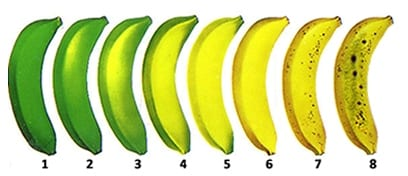
The Stages of Ripening a Bananas
Armed with this information, I didn’t know about the gas before, but I knew the hack – many people know to put these fruits in a paper bag to ripen. So, if that banana pudding is due for the Sunday social and you have green bananas on Friday, toss them in a bag, roll up the top of the bag, and in a day or two, you won’t disappoint that hungry crowd.
The black banana-loving people can do the same thing to kill … eh – age their speckled bananas faster – and they can experience total bliss.
What about a bunch of bananas that are going to age all together like a bunch of racehorses, all getting to the finish line at the same time?
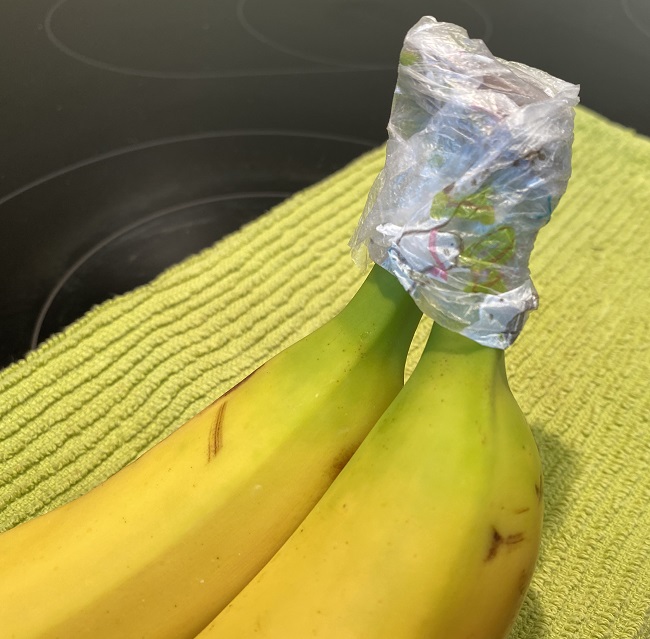
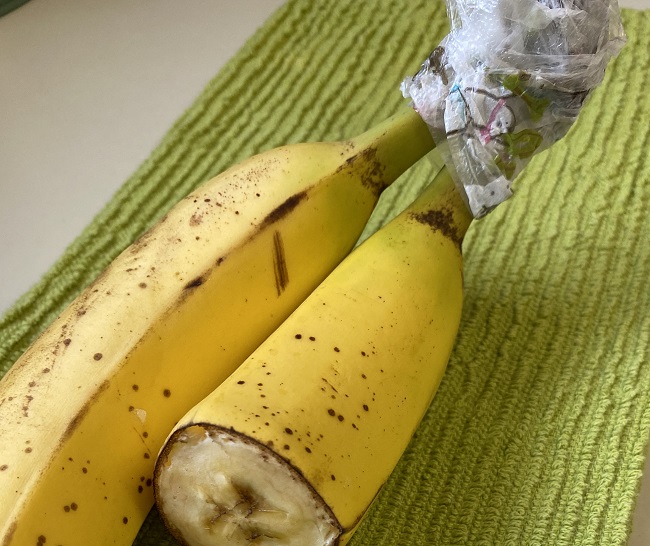
Instead of going to the store to buy one banana a day, simply pull off the one you’re going to eat, and then … drum roll … wrap the stem end of the remaining bananas – where they hold together – in plastic wrap.
Cue the angel choir: “Ahhhhhh!”
Yes. This is me, recommending the use of plastic wrap. Even better – use the sticky kind (Press and Seal). This is the hack I learned from my friends.
When plastic wrap seals in the ethylene gas, keeping it from escaping, it won’t wash over and ripen the bananas. Pretty cool. Now, you will not be able to keep a banana green for a week, but you can easily extend the counter-top life of bananas so you can consume them to your desired level of ripeness.
And … oops … this is a third hack … the banana’s ethylene gas is also ripening your avocados. Remember, avocado is part of this gas-producing group. It’s best to separate counter space for those two items by several feet.
Just saying, because you don’t want to miss that 15-minute, magical time frame when your avocado is perfect because its neighbor has gassed it.
As always, please click on the MORE button below to discover all the options to share this helpful article. And to my dear readers in Poland, feel free to translate and share with your friends!
Why are there baked home fries from white, and sweet, potatoes on my plate tonight? Why are cantaloupe, salmon, bananas, and more spinach on my shopping list? What possibly could be missing?
Precisely!
Something is missing, and this detective was pretty sure of the culprit …,er, the missing one.
Problem? Maybe you are familiar with those troublesome foot spasms that occur in bed – usually in the morning hours for me, just prior to rising – that can only be fixed by standing up to gently return the tortured foot into proper alignment?
This had been going on with even greater frequency lately. Coupled with a few other seemingly random symptoms, I was wondering if, maybe, I was just in a total mind/body/spirit funk.
Have been there and done that before with foot spasms, but the other complaints were new to me. After reading the article HERE, I was able to put things together. Let me summarize signs and symptoms of possibly being low in a vital nutrient: Potassium.
You may have low potassium if you are experiencing:
Weakness and fatigue – Low potassium can interfere with blood sugar levels, depriving muscles of the energy they need.
Muscle spasms and cramps – BINGO! Therefore, athletes are very careful about their potassium intake.
Digestive problems – let’s just say things slow down…a…lot. Also, there’s bloating. Check.
Heart palpitations – not to be confused with serious heart issues that are not fixed by a meal high in potassium. Starting to check this, too.
Muscle aches and stiffness – Again, the pathways to proper muscle function are disrupted.
Numbness and tingling – When nerve pathways are affected, it’s best to contact your doctor.
Breathing difficulties – Potassium pathways for proper muscle function and communication may become disturbed with severe deficiencies.
Mood disorders – while more research is needed on this one; there is a correlation of mood disorder patients being low on potassium. I certainly could check this box off as my usual chipper inner — self seemed to be in a funk.
What to do? Most people know to eat bananas for potassium, but there are other choices that are even better. The following table shows the ranges of potassium level to consider when choosing food sources:
What is the recommended daily allowance for potassium, you may ask? There ,actually, isn’t an official RDA, but the umber of 4,700 mg a day is the consensus. Not surprisingly, most people are deficient.
Armed with these target ranges, let me give you a short list of high-potassium foods I gleaned from this source HERE:
Artichoke 345 mg.
Banana 425 mg
Beef, ground 270 mg
Beets 260 mg
Dried peas and beans 300-475 mg
Haddock, perch, salmon 300 mg
Lentils 367 mg
Milk 350-389 mg
Baked potato 925 mg
Prunes 305 mg
Spinach 420 mg
Baked sweet potato 450 mg …
There are more, but check the resource cited above for serving amounts and other options.
The caveat comes for those using the lite versions of salt which are formulated with high levels of potassium. Work with your doctor about balancing potassium and sodium levels.
Additionally, let’s not jump off the cliff with this.
Geez you give some people an inch, (read ground beef and white potatoes), and they’ll start eating hamburgers, French fries, and loaded baked potatoes saying I told them it was good for their potassium levels.
No. No. And no.
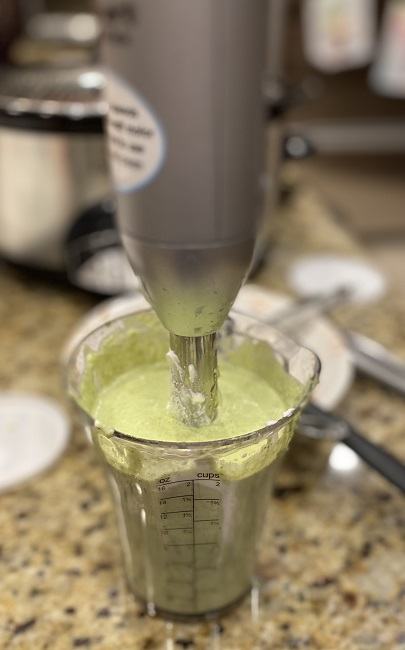
Think of dinner consisting of baked fish, one HALF of a potato (I like to cut them into home fries, toss in a bit of olive oil with salt and pepper, and bake), along with a generous green salad with that creamy yogurt-based dressing I shared recently. Evening snack of a small bowl of cantaloupe (also on the list) and ½ banana.
No cramps this morning. Just sayin’.
In health-
Deidre
Please share this article with others by clicking on the MORE button below for sharing options.
Of all the things I’ve lost, I miss my brain the most.
Concern over loss of brain function seems to increase as we age, but research is showing that decreased brain function can even happen to young children if certain factors are in place.
Is this another hole-in-the-dam we need to plug? Absolutely. Like most problems, the causes are related to other things. Solve one or two, and a whole host of problems can be avoided.
peripheral nervous system
Today, I want to shine a light on BDNF, (Brain-Derived Neurotropic Factor), whose presence is a key player in excellent brain function, and helps our peripheral nervous system, (AKA the nerves of our body outside of the brain itself). BDNF is a protein found in the brain that helps to ward off brain cell death and promotes the growth and development of new brain cells – along with their thousands of connections to other nerve cells.
Decreased levels of BDNF are associated with Alzheimer’s, premature aging, poor brain functioning, obesity, depression, and mental diseases.
Knowing ways to increase levels of BDNF in our brains just might be the impetus to tweaking some health habits. There’s nothing like motivation. Thing is, the answers to how to increase BDNF are not new, but the seriousness of being low on BDNF just might be the swift kick we need to make some changes. I know I am.
Intense Exercise is a crucial tool to increase/restore levels of BDNF, and obviously, has other benefits as well: Increased circulation to the brain, improved heart function, release of happy hormones, improved muscle and joint function, and … hello … helps with control of weight. A single trip to the gym to raise your heart rate one time, won’t tide you over for a month. Consistent effort with 30 minutes of aerobic exercise several times a week will do the job – over time.
Since pulling back from gyms during COVID, I had not returned. Simply relying on my home routine of daily planks, (I’m up to 7 minutes a day), using free weights, and walking has not been enough to boost my brain health or mood. Elliptical machine, here I come!
Intermittent Fasting (IF)/Caloric Restriction have been found to improve not only brain health, BDNF levels, but also heart function and better regulation of glucose levels. There will be a post about IF (Intermittent Fasting) soon. IF is when the fast of the night is extended into the late morning. More on this later.
Saying goodbye to refined sugar and saturated fat will also play a big role in not only raising BDNF levels, but in weight control and glucose regulation. Cutting back on sugar can be problematic because it really is addictive. As I stated on page 121 of, Toolkit for Wellness, sugar actually lights up the opiate receptors in our brains. If you haven’t done so already, start cutting down on sugars little by little; once you ultimately break free of the addiction, sweet things will not be calling you like sirens from the deep. Sugary foods will taste too sweet to be pleasurable – a smaller portion of any sugary treat will more than do the job.
Regarding saturated fat, keep fat selections to modest amounts of less refined good fats – including olive oil, avocado, nuts, and seeds.
Sunlight is another booster to BDNF. Studies are showing that BDNF rises and dips according to seasons and levels of ambient light.
Supplements to consider that raise BDNF production include curcumin, green tea, omega-3 fatty acids, and resveratrol.
Losing weight at any age will assist in increasing the production of BDNF. The nationwide trend of obesity in the young is startling, not only because it’s the first domino to fall toward diabetes, heart disease, and stroke, but because the developing brains of obese children are low in BDNF. Now, it may be a case of the chicken and the egg with childhood obesity and BDNF – they correlate with each other, but addressing the trifecta of sugar/fat consumption, decreased exercise, and lack of social interaction, (next on the list), will go a long way to improved brain health.
Being socially engaged has been an issue during COVID, to be sure. It wasn’t just in our heads … although, really it was … that our brain functions were sluggish and low during our isolation because the BDNF levels were, too. Yes. We are social creatures and it’s no coincidence we are feeling mentally refreshed as we take our vaccinated selves back into the world of smiling faces.
Here’s to increasing levels of BDNF to boost our brain health for life. I’m returning to the gym with my exercise buddy tomorrow, who is also in Noom. Weight mastery, exercise, and social interaction – what could be better?
In health and BDNF –
Deidre

As always, if this article was useful to you, please pass it on by clicking on the MORE key below to share on a multiple of platforms.
At last, we are getting out to restaurants again – a chance to reconnect and to enjoy food not cooked by us. See if this a familiar scenario: You are going to meet up with a couple friends with whom you have not socialized since early last year.
For weeks prior to getting vaccinated and going mask less.
However, you had started a campaign to get rid of those pounds that had crept around your waist in the last 18 months.
You’re thinking you might have a salad with grilled meat on top when one of your friends chimes in with, “Man, it’s so good getting back out again with you guys! Let’s go whole hog and celebrate! First round is on me AND there will be dessert! Yay!”
You look to your other friend who was considering the salad menu as well but puts it down declaring, “You’re right! This is going to make up for over a year of deprivation! I hear their lasagna is to die for, and the breadbasket is bottomless!”
You probably know how this meal will go. Who are you to diminish the party by drinking water, saying no to the alcohol, lasagna, bread, AND the dessert?
It’s human nature. Apparently, we cannot shake that primordial instinct to exist more safely in a group. That desire to belong, to be in the safety of numbers, and looking to others for a consensus is played out every day.
Even if it is to our detriment.
Being swayed by the input of others is often called “norm matching.” It can govern not only what you choose to eat, but when you pick up your fork (when someone else does) and even matching your consumption to others.
I was reintroduced to this concept in terms of food choices in the Noom cour, I have spoken about. [This link will get you 2 weeks free on Noom and a 20% discount. I will receive monetary thanks from Noom if you use it.]
As I did a little research about norm matching, the link to Solomon Asch’s famous conformity experiment from the 1950s quickly popped up. Look at the image of the two cards below:
The assignment is to choose either A, B, or C, to be the match for the line on the card to the left. There were many sets of cards needing matches such as this one in his experiment.
Not rocket science.
Only 1% of those being studied chose incorrectly when their answers were given silently and anonymously. Open the floor to discussion, introduce some clearly incorrect responses by some planted actors, and 75% of the people being studied went along with the false consensus at various times during the study.
All in the name of conformity.
Which begs the question. Who’s driving your bus?
As I was researching today, a recent conversation with a friend popped into my mind. My friend was concerned about a family member who is following the lead of a circle of friends who believe that being vaccinated against Covid is unnecessary because Covid is not real.
Sigh.
Whether the choice is lasagna vs. grilled chicken salad or getting vaccinated or not, do your due diligence at your research of valid, verifiable, science. Look at your resource; check credentials; get input from a variety of sources.
Order you meal first. Maybe you can lead the crowd by saying that you’re celebrating getting together by honoring your body with a healthy choice.
My concern – more than food choice, however – is whether the person at the next table to you – who has delayed getting vaccinated – will get Covid from you and require hospitalization.
For more information about the Covid vaccine, check out this helpful WEBSITE.
In the words of Fiona Robertson in Norm Matching (fionarobertson.com): “You can’t change the way human brains are wired, but if you understand them, you can work with them instead of against them.”
If this post was useful to you, please share with others by clicking on the share button below and don’t forget to subscribe through the box on the left so you never miss an issue of FoodTalk4You!
Remember the story of the little Dutch boy who stops a dam from cracking and flooding the town by plugging the hole with his finger until adults could come to the scene to affect a more permanent solution? Legend has it that he stood there all night before more help could be obtained.
Judging from just the cursory view last week of what is an autoimmune disease and how it might happen, we could conclude that our dam has more than one hole. In fact, we are running out of fingers to plug all the holes.
Where are the holes? Look to the millions of us with autoimmune diseases and see if there is a common experiential thread…
In the residual chemicals found in our food from growth practices
In the chemicals added to our highly processed Western diet which is also high in sugar, fat, and salt
In the consumption of food that is pro-inflammatory
In the polluted air we breathe
In the chemical exposures we subject ourselves to in cleaning products, toiletries, and cosmetics
In the chemicals we use in our yards and gardens
In the stress hormones of the feedlot animals we eat
In the chemical transfers of packaging, storing, and cooking food in plastic products
In stress
Eventually – in the air, as we breathe nano dust particles of plastic which do not decompose but just degrade into smaller and smaller pieces
Clearly, there is no one answer, but taken as a whole, it is easy to see that the world we have created is not the world our genes were built to withstand.
As promised, I want to bring up just one facet of how genetically susceptible people might be opening the door to the lurking wolf on the outside. And I believe that there are more of us genetically susceptible than we may realize.
Dr. Alessio Fasano
Let me introduce you to Alessio Fasano who is a world-renown physician and researcher. He holds numerous positions both in Boston and in Italy. To read his biography HERE: Alessio Fasano – Wikipedia is to be awe inspired and grateful for all the lives he and his teams are helping.
In 2000, Dr. Fasano discovered a protein in the lining of our small intestines called zonulin. The lining of the small intestine is just one cell thick. Touch your tongue to the side of your cheek – that’s the same sheet of cells that extends from our mouth all the way through our digestive system to the very end.
Thin, yes, but strong and resilient to keeping our insides in and the outsides out. Each cell is connected to its neighbor by what’s called a tight junction.
Better be tight. Lots of stuff in the pipeline. Don’t want random particles of food or toxins punching through to the other side without first being properly broken down and absorbed by the blood stream and taken through several filters.
Turns out zonulin is a moderator of sorts for what can get through this layer of cells. An uptick of zonulin will cause these tight junctions to open wide, allowing large, foreign/non-self materials to flow through to the gut tissue and eventually be absorbed unfiltered by the blood stream and land anywhere in the body.
Because these large particles are foreign, our body will wage an attack.
According to Dr. Fasano, “When the zonulin pathway is deregulated in genetically susceptible individuals, autoimmune disorders can occur.” Check out this list of autoimmune diseases to see if you can find what has been plaguing you and if you might be genetically susceptible: Autoimmune Disease List • AARDA
This brings us full circle. Remember those questions I posed for us to ponder a couple weeks ago?
Can you see a DON’T TOUCH – WET PAINT sign and not touch the surface it’s indicating?
If you know a certain food will cause an immediate harmful reaction in your body, will you eat it anyway?
Is there a habit you have or a food you eat that will most likely cause problems for you down the road, but you justify continuing it by saying, “I’ll stop when it starts to bother me”?
It might be time to check out some anti-inflammatory practices found in my book, Toolkit for Wellness, to see if you could be more proactive in controlling your health destiny.
I am doing this for myself as well, as I continue my experiment of eliminating my beloved grits and oatmeal.
Since following my Noom way of eating starting this February, grits and oatmeal have become a staple in my morning. Simultaneously, my hips and knees have been complaining. This is not the first time I’ve experienced this potential cause and effect.
Knowing that many aches and pains are self-induced, I’m accepting responsibility by eliminating a couple foods I love to see if the picture improves. Who wants to bet that grits and oatmeal are inflammatory to me?
Time and abstinence from delish menu items will tell the story.
Before I start my mini-series on autoimmune diseases, I want us each to consider our individual level of commitment to mindfully guiding our health outcomes.
Let me pose some questions.
Can you see a “DON’T TOUCH – WET PAINT” sign and not touch the surface it’s indicating?
If you know a certain food will cause an immediate harmful reaction in your body, will you eat it anyway?
Is there a habit you have that will most likely cause problems for you down the road, but you justify continuing it by saying, “I’ll stop when it starts to bother me?”
Why am I offering this discussion in the first place? Because we are in the middle of an explosion of people suffering with autoimmune diseases … in a way not seen before.
Judging from the descriptions of my friends on Facebook, their autoimmune-challenged lives are constant torture – filled with inexplicable bouts of painful, life-disturbing days when even just lying around can be a challenge.
Is our human race crashing and burning?
Rather than crumbling strands of DNA inside of us, it may be a case of having to be ever more knowledgeable, vigilant, and proactive about our internal and external environments
As readers know, I believe we are designed for health, not disease. Foodtalk4you investigates what we are using to fuel our engines, offers ideas on making changes based on knowledge and experience, and then explores what we can do to restore much of our lost health and vigor.
The world of autoimmune disease seems to be growing exponentially. The coming posts will not solve all your problems, but may open your eyes to possibilities.
In the world prior to this autoimmune explosion, life was simpler, food choices were fewer, and air was cleaner. We also had fewer cures, limited access to medicine, and little knowledge of how deadly many things were – smoking is one of them.
Let’s not go back. We are in the present, dealing with today’s world.
First, just consider what your commitment to your improved health might look like. Are you willing to wait until something hurts, or are you willing to be proactive now, so it won’t hurt later?
Think about it.
Deidre
Don’t miss a post. Sign in to receive our weekly newsletter – look to the box on the left!
Have I been anything but brutally honest with you? No, I can promise you, I haven’t.
This week is no different.
First, a big shout out to my dear friend and editor for foodtalk4you, Sheree Alderman, for pitching in on the writing side of things with her post, Life in the Stairwell. When she told me of her experiences during those scary hours leading up to, and during, the tornado, I immediately knew it was a story best shared in the first person.
Which was very timely for me, because I was seeing both of my adult children and grandchildren, simultaneously, for the first time in fifteen months! Fully vaccinated – except for the children, at this point – we shared hugs, laughter, delicious five-star restaurant-worthy home cooking, the warm spring weather, walks with two rambunctious and loving Goldendoodles, and happy family trips to nurseries for spring herbs and flowers.
In other words, a slice of heaven for this mother.
Just hearing my son and daughter, who are separated by 3 thousand miles of land plus an ocean, as they talked, laughed, and caught up with each other – made my heart sing.

Ten days of blissful memories carried me through being solo on Mother’s Day.
Still smiling here.
That brings me to EBS. Empty Brain Syndrome. Yup. I’m blaming EBS for my lack of fresh ideas. It’s a part of the umbrella diagnosis of PVS. Post Vacation Syndrome, which may be familiar to you.
PVS is now placed under the new diagnostic category of: First Time Getting Together with Vaccinated Family After Being Isolated in a Global Pandemic Syndrome. FTGTWVFABIIAGPS.
All I really want to do is sit outside, enjoy the sounds of nature, drink coffee/fuzzy water/wine, and just BE.
And prop up my sprained ankle with an ice compress – that’s another story, altogether – still savoring the happy feeling in my heart full of warm memories, while also planning on making more.
Hmmm.
This EBS/PVS/ FTGTWVFABIIAGPS is not such a bad thing after all.
There’s not a stressful thought, feeling, or twitch on the horizon.
When was the last time you could say that?
I think the dark night of my soul during February and March has passed. Nothing that a little sunshine, the safety of being vaccinated, and being around family again couldn’t cure.
Now, about that Empty Brain thingy…
Make sure to subscribe to foodtalk4you to easily receive next week’s post about some mindful exercise and body check-in techniques I learned about during vacation. The brain is beginning to percolate.
By now, most everyone has probably heard about the storms that ravaged the great state of Texas this past week. Of course, they’ve damaged a lot more areas, but I currently live in North Fort Worth, which was particularly hit hard by some very unique, brutal waves of high winds, hail, and even a possible tornado.
When you live in Texas, you soon realize this type of weather is not that unusual, especially in certain areas of the state, and sometimes kick off angry thunderstorms that march straight into Arkansas, Louisiana, and sometimes bolt north into Oklahoma. All this can happen in a matter of hours; and – at times – without much warning.
On the morning of April 28th, the day started out pretty normal. it was full of sunshine and pleasant temperatures, with no peculiar or alarming weather broadcasts for the day. However, I did see where the National Weather Service, NWS, mentioned earlier we had a particularly good chance for an evening shower.
I went about my day, texting my daughter, Abby, to let her know she might want to keep in mind we could have a storm later on in the evening. They are a family on the go, with three children – one being old enough to drive.
Truthfully, I don’t think anyone takes me seriously in these situations, but I trudge forward and hope for the best. After retiring from Emergency Services some years ago and having lived in an area where we got yearly hurricanes – and tornados from them, I did take it seriously, very seriously. I’ve seen what a powerful storm can do, and I keep a healthy respect for each and every one of them.
So, Wednesday, April 28, 2021, started out as any other day.
About 5:00 o’clock that evening, I was scouring the Internet for various ideas while sitting beside the window of my apartment, when out of the corner of my eye, I noticed a flash. I immediately knew it was lightning. As I looked more closely, the lightning started coming quicker and closer. Kind of like when the DJ kicks up the strobe lights on a fast tune that’s so loud, your spine vibrates.
They still do that, right?
My apartment overlooks a courtyard and business office and is visible for miles when you look straight out. Over the next 20 minutes or so, I watched the lightning start to evolve from what seemed to be miles away – to light up across the street. It seemed to get a lot closer a lot quicker – and the sky a lot darker.
By this time, I was getting more concerned about an electrical storm they were now projecting. I kept checking my phone for the weather update when things went bad to worse. Going online to some of my favorite weather reporters, they were running constant radar on our location and, by 6:30 they were saying there was a super cell with tornadic activity in our area.
In fact, moments later, a slow rotation was starting to pick up. I knew immediately that meant a tornado was forming, whether it would develop into a full-fledged tornado or not, remained to be seen. However, the lightning was like nothing I had ever seen. It, at times, looked like the lightning was striking four and five times within a second in the same area. This lightning was going right down to the ground. I could tell as it progressed, it was getting closer and closer to me.
Now the weatherman was starting to alert us that hail was on its way -and I start to have tiny pellets of it hitting all my windows. He had an alarm in his voice you never want to hear, telling us to be prepared – we have rotation on the ground, very large hail coming your way, and get prepared to go to safety quick.
I could literally, see the storm forming in front of me with a lighter sky on the right, where it had pulled the dark clouds in, and on the left was gray. But in the very middle was this giant, angry, black ball of swirling hail and debris.
Within minutes, the weatherman was spitting out the tornado’s coordinates – and it was exactly the location of my apartment. Although, I have been thoroughly trained to handle situations such as this in my career, it is an entirely different issue when you are standing in your window, seeing this monster coming at you. Within seconds, what sounded like pebbles were now large rocks of ice hitting the windows – so hard – I thought the glass would surely break in a thousand pieces.
At the same time, what they now refer to as gorilla hail, started hitting my windows, and tornado sirens started screaming in all directions. It was directly upon us. As the tornado winds and hail swirled into my windows, the National Weather Service loudly paged my phone, telling me to get to shelter – in a basement, a cellar, or somewhere safer than where I was – our storm had now upgraded to a tornado warning – they were seeing one in our area.
I just stood in the middle of my apartment terrified. What do I do? Where do I go? I hurried to my door which led out into the middle of the building, then turned back to my windows, and kept repeating that behavior a few times. I finally decided I was risking my life to stay; but where I do I go? I just couldn’t believe this was happening.
As I finally stepped out of my apartment and into the corridor, I nearly ran for the stairwell. The sound of the hail and debris hitting everyone’s windows was deafening. You could not have had a conversation with anyone out in that hallway.
There’s only one place I could think of to go – the stairwell beside our building’s elevator. At least there are no windows there and I would be surrounded by cement blocks and iron.
I thought to myself, there is no way I am going to have any windows left when I get back here; but I hurried as much as I could, heading for the relief of the stairwell. At least there was less chance of this thing getting to me there.
You might think after me telling you all of this, there would not be much good news – but you are mistaken. As I reached the heavy door of the stairwell, I could hear voices. Many voices. I saw familiar, happy faces smiling at me as I stepped into a peaceful atmosphere.
There were neighbors from all three floors sitting inside with their dogs and cats – a lot of them chatting about a variety of topics. One person had an emergency radio, many had their cell phones and tracked the storm that way, some didn’t have anything to rely on but just trusted those around them.
The most touching part of the stairwell was the beauty of the genuine, deep concern for one another. If someone had a need, another would take care of it. They found chairs and blankets and water for each other. People would think of a neighbor that wasn’t there and volunteer to go get them so they would be safe.
Down in the stairwell, there were people of every color, every religion, every walk of life – and none of that mattered to anyone. People were praying out loud for our safety and the storm to pass. Some were singing praises. Periodically, someone would holler out where we were in the hot zone, right up until the time we had passed through it and were okay. I learned more that night than just where to find safety in a storm.
It was a beautiful place to be, and I thought of how heaven might be just like this. I remember sitting there at the top of the steps, looking about, and thinking, I wish the world could see all of us piled in this one little part of a stairwell – the room bursting from the gentleness of the human spirit – bonding us together always. My heart was filled from witnessing the kindness of others.
Some of us may have been complete strangers going in, but we sure were besties going out.
Never underestimate the storms of life that come to you, because they just could lead you to the stairwell and be a blessing in disguise. I know where I’m headed if another storm comes my way.
God bless us everyone.
Sheree Alderman,
Editor-at-large,
N. Fort Worth, TX
Over and out!
Please sign up for the FoodTalk4You newsletter. Just fill out the quick form on the left of this page!
I am bringing rose buds, African daisies, and chive flowers into the house, just to bring that spring vibe indoors.
My Aussi and Kiwi readers, I know, are now nestling into the fall season of harvest: but spring has sprung in the Northern Hemisphere! We are just now setting out new plants in anticipation of colorful blossoms and produce to come.
Ah, the faith of a farmer – gardener!
It seems to touch us all. My regular trips to the local garden center are showing every age, socio-economic level, race, and gender walking the isles of seedlings, young blooms, fertilizer, chips, and bags of “dirt” as we all seek the color and promise of outdoor life in the coming months.
No longer are we indulging in out-of-season fruit grown in South and Central America. Our strawberries are coming from the United States and, man, are they sweet!
Our local strawberry fields are ready for customers. My neighbor sent me a picture this morning of her cardboard flat filled with ripe strawberries after just a short time of easy picking.
Are visions of strawberry cakes, pies, layered truffles, and jam filling your head?
Not mine.
I’m relishing every bite of fresh berries possible.
Sporting an average of 4 calories each, strawberries are a filling, SWEET, food and are satisfying and good for the body. Woohoo!
A quick check on their nutritional benefits HERE will remind you why strawberries are so beneficial. To summarize:
Strawberries are 91% water and just 7% carbohydrates – 26% of the carbohydrate is comprised of fiber, so the net carb content is low.
The soluble and insoluble fibers found in strawberries help contribute to great gut health by feeding the good bacteria found there.
The high fiber of strawberries contributes to their low Glycemic Index which helps prevent blood sugar and insulin spikes.
Strawberries are a good source of Vitamin C, manganese, folate, and potassium, as well as several other vitamins and a host of antioxidants that decrease inflammation and oxidative stress.
Why add empty, white flour carbohydrates, cholesterol-raising saturated fat, and even more carbohydrates in sugar to something that screams PERFECTION and HEALTH?
Looking for hors d’oeuvre? People will rush to get a fresh strawberry.
Want to ramp up your oatmeal in the morning or as an evening snack? Add a dollop of non-fat Greek yogurt and several sliced strawberries. Simply divine!
Looking for an awesome snack? Several fresh strawberries will rock your world, without rocking the calories or the blood sugar.
There are some folks who are allergic to strawberries, especially young children and people with sensitivities to birch pollen or apples, who may have symptoms after consuming strawberries.
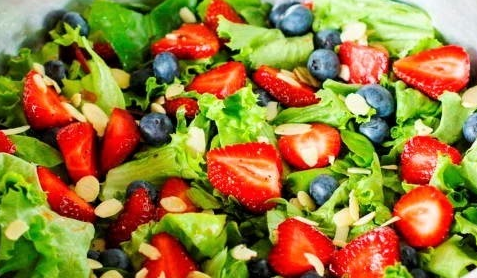
Until the blueberries are available sometime in late May or June, fresh strawberries will be gracing my breakfast, snack, salad, and dessert plates for a while.
How about you? Are you going to choose strawberries in the raw without the detractors of flour, sugar, and fat?
Our editor, Sheree, advises to pick only the fully ripe strawberries because they will not ripen after picking – they only age out.
If you liked this post, please click on the share button to spread the word. If you are not a subscriber to foodtalk4you, please click the subscribe button so you won’t miss the next post – we promise not to share or sell your email address and we will not bother you with endless sales pitches.
I believe personal growth starts when the comfort zone is in the rearview mirror.
That’s what happened on April 12th, seven years ago. Goodbye comfort zone. Hello, foodtalk4you.com!
The thing to understand is – growth is not linear. When you grow in one direction, little accompanying offshoots spring up and out from your initial effort, all requiring additional growth.
My musings about total body good health out there for the world to read?
Geez. Who was I? How do I even start?
Hostgator? Domains? WordPress? What’s all that?
Foodtalk4you has led me to self-publishing, marketing, advertising on Amazon, to putting a full-fledged, free course on Teachable.
So far.
Maybe you are actualizing your desire to watercolor; it’s not something you’ve ever learned how to do. Maybe you have never done anything artsy before.
First comes learning about what kinds of brushes you need. Then comes the type of paper to use. Where or how are you going to learn watercolor techniques? Pretty soon, you are conversant about different kinds of paint, types of palettes – maybe even easels.
You start out with a simple still life and then discover the world of plein air art. Shading. Light. Perspective. Focal points. Seasons. Now, there’s matting and framing to consider.
You have amassed a sizeable collection of paintings that you now want to share with the world. You learn about getting a booth at the local farmer’s market and then you learn how to attractively present your beautiful pictures.
Business cards? Well, there you go. You learn how to design them. You learn where to get them printed.
One of your watercolors was bought by an elementary school teacher who asks if you would come to her class to demonstrate to the students the basics of how-to watercolor. You, teaching others? Now your comfort zone is really being stretched. But you go for it, and the students were wonderful, talented, and they hung on your every word.
Eventually, your tiny little shoot of growth has matured into a thriving tree with many branches. Bravo!
Stepping out of our comfort zones is where life is. Where there’s life, there’s growth.
So, go ahead. Step out of that comfort zone. It’s just one step, but it will lead to many others. Pretty soon, you’ll look back and marvel at all you have accomplished.
Happy seventh birthday, foodtalk4you! The trip is just getting started!
If you were inspired by this post, please share on social media.